
Our Vision: AI That Understands How Your Organization Works
Moving beyond isolated prompts and linear automation toward an AI system with deep organizational context and graph-based knowledge.
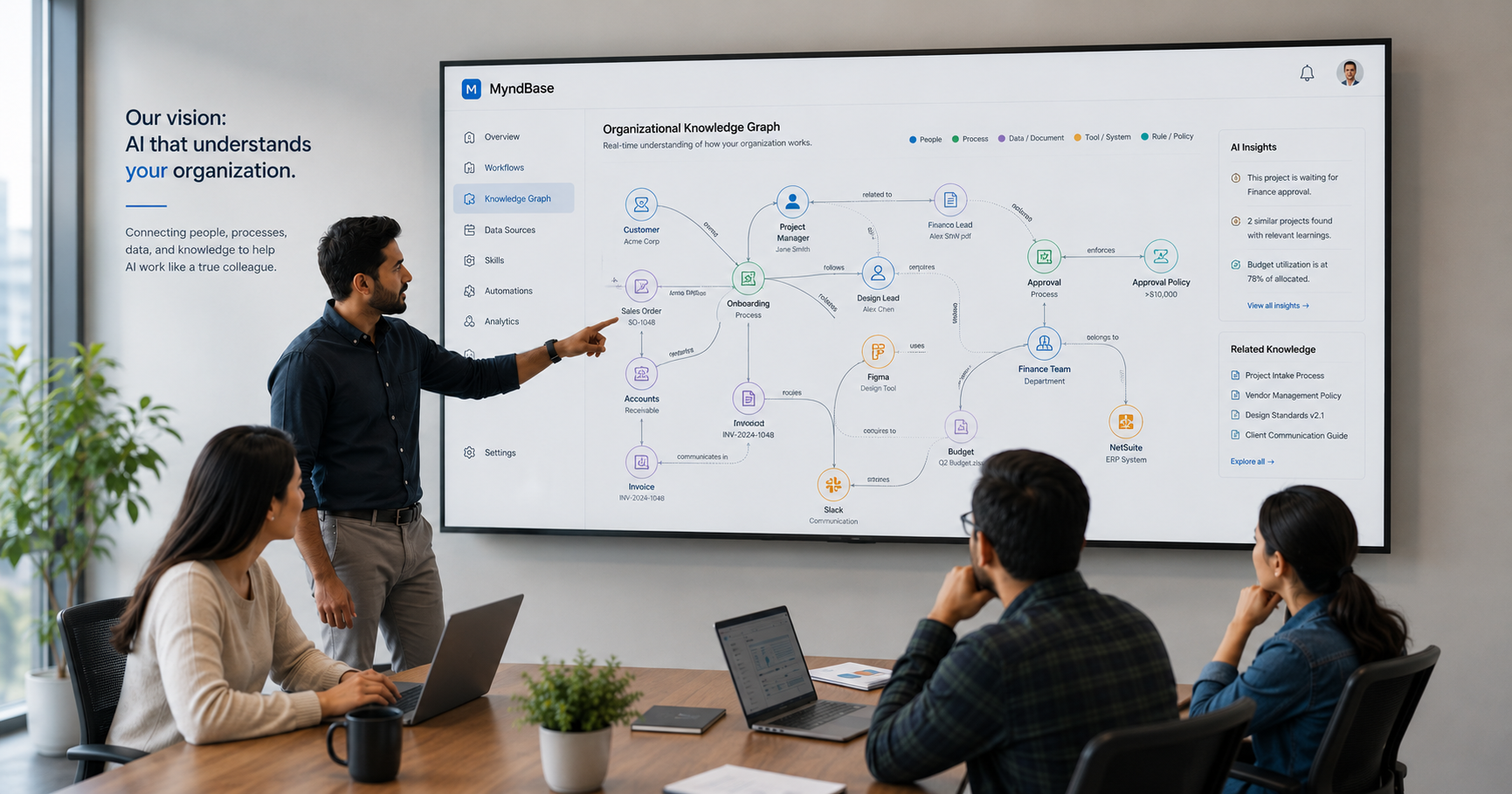
AI can already write, summarize, analyze, search, and automate individual tasks. But an organization is much more than a collection of individual tasks.
A company has people, departments, processes, documents, decisions, tools, rules, relationships, and knowledge built through years of experience. Understanding how all of these pieces work together is a much bigger problem. This is where we believe the next stage of organizational AI needs to go.
Beyond Workflows and Automation
Our current product focuses heavily on workflows and automation. We believe this is the right place to start. Workflows give AI a way to participate in real processes. Skills give it rules and instructions. Storage gives it access to organizational information. Plugins allow it to interact with the tools people already use. Explore our early access features.
But these are starting points. Our larger vision is to build an AI system that can gradually develop a deeper understanding of how an organization actually works—not just what documents contain, not just what individual tasks need to be completed, but how the different parts of the organization relate to each other.
Understanding Relationships
Organizational knowledge is highly connected. A document may relate to a customer. A customer may relate to a project. A project may depend on a particular process. That process may belong to a department and require specific people, tools, approvals, and rules.
Traditional retrieval can find relevant pieces of information, but understanding these relationships can require something more.
One area we are exploring is a graph-based knowledge layer, including approaches such as GraphRAG, that can help represent relationships between organizational information and make those relationships available to AI. This could allow an AI system to reason about connections across the organization rather than treating every piece of information as an isolated document or text chunk.
This is one part of the direction we are exploring as MyndBase evolves.
Skills That Evolve With the Organization
We also believe that AI skills should eventually be more than static instructions written once by a user. Organizations change. Processes change. Teams change. Tools change. Decisions create new patterns. People develop better ways of doing things.
We want to explore how skills can evolve through the workflows an organization runs and the information generated through those processes. Over time, this could allow MyndBase to develop a better understanding of how a particular organization performs its work.
The goal is not simply to give an AI more instructions. The goal is to help AI understand the operational context behind those instructions.
AI as a Colleague
Our long-term vision is not to build AI that simply performs isolated commands. We are interested in the idea of AI as a colleague within an organization.
A useful colleague needs context. They need to understand what the organization does, how teams work together, what processes exist, what rules matter, where information comes from, and when they should ask someone for help. They also need to know what they do not know.
This is why human interaction remains important to our vision. We believe building an organizational AI system will require continuous communication with the people who understand the business—domain experts, team members, managers, and other people who actually operate the processes.
AI should not replace that organizational knowledge. It should learn from it and make it more accessible and useful.
System Design Comes First
As we build MyndBase, we care deeply about the underlying system design. We do not want to simply keep adding AI features because they are technically possible.
We want to think carefully about principles such as context, permissions, relationships, reliability, human control, extensibility, and how information flows through the system. These principles will influence how MyndBase evolves.
The current product may look simple compared with where we ultimately want to go. Some of our current approaches may change as we learn more. That is expected. We are starting somewhere.
Starting With Workflows
Workflows are our starting point because they provide a practical way to introduce AI into real organizational processes. They give us a place to observe how AI interacts with information, rules, tools, and people. From there, we can continue building deeper layers of organizational understanding.
The long-term direction is not simply "Automate more tasks"—it is "Help AI understand how the organization works." That is a much larger problem, and we know it will take time.
Building the Vision With Real Organizations
We do not believe this vision can be developed entirely from a product roadmap. Understanding an organization requires understanding the people who operate it.
That means listening to domain experts, learning how different teams actually perform their work, understanding where processes break down, and continuously learning from real usage.
This is also why our early adopter program is an important part of the MyndBase journey. Join the MyndBase Early Adopter Program.
Early adopters give us an opportunity to learn alongside real users while the product is still evolving. Their feedback can help us understand not only what features to build, but what an organizational AI system should fundamentally become.
The Beginning
MyndBase today is only the beginning. We have started with workflows, storage, skills, plugins, and human-in-the-loop capabilities because they give organizations something practical to use today.
But our vision is larger. We want to explore what it means for AI to understand an organization as a connected system—not just a collection of prompts, documents, and automated tasks.
There is a lot we still need to learn and build. We are excited to start that journey.
Other Articles
Explore more insights from our team.
Early Access Features You Can Use Today
Explore the first set of features available today in MyndBase, from agentic workflows to persistent file storage and custom AI skills.
The MyndBase Early Adopter Program
Join our Early Adopter Program to test capabilities, share feedback, and help shape the operational AI platform built for real-world teams.